
[Original by Hiroshi TANIYAMA, JVC’s President (August 23, 2016); Translated by Y. Nakamura] Modern war is protracted one Most of modern wars take the form of “anti-terrorism war”. An “anti-terrorism war” does not have a distinct front line of fight, and cannot always differentiate between a combatant and noncombatant. A characteristic of modern war is meant to be “a war fought among residents”. Consequently, civilians would be more liable to damages. Furthermore, it is very difficult to negotiate ending the war because the side of “terrorist” rarely has a chain of command like a state does. Therefore, the war is likely to be protracted. Learning from the case of Afghanistan…
Staff Interview: Junya HOSONO (Deputy General Manager)
[Original by Yuka WATANABE, 2015 Public Relations Intern (November 18, 2015); Translated by S. Thapa/Y. Nakamura] Hello everyone, I am the public relations intern Yuka Watanabe. In our third installment of staff interviews, we have Mr. Junya Hosono, Deputy General Manager. Mr. Hosono is in charge of various range of things at the office, including general affairs and labor. To be honest, Mr. Hosono is a little bit unusual in an NGO setting. He is a Systems Engineer (SE), a ‘techie’. How did a systems engineer get into the path of international cooperation? Let’s ask and find out. What led you to participate in the field of international cooperation? Initially,…
WAR IN SOUTH SUDAN INTENSIFIED; IS IT RIGHT THAT SDF’S PKO KEEPS STATIONED?
[Original by Hiroshi TANIYAMA, JVC’s President (July 21, 2016); Translated by Y. Nakamura] Fierce battles happened in Juba, a capital of South Sudan, where Japanese Self-Defense Forces (SDF) were dispatched under United Nations Peacekeeping Operations (PKO). More than 270 persons have been killed in gun battles which started on the 7th of this month. It is said that the actual number of civilian casualties was more than that. It produced more than 40,000 refugees. Food shops were looted, and transportation of goods was stopped by inspection. They were worried about food shortage. Both opposing parties, president’s supporters and vice-president’s, issued an order of cease-fire. However, there is still some possibility…
Staff Interview: Takatoshi HASEBE (Secretary General)
[Original by Yuka WATANABE & Haruka SHIMIZU, 2015 Public Relations Intern (November 12, 2015); Translated by S. Thapa/Y. Nakamura/A. Guermont] Hello, I am Yuka Watanabe, PR intern. The second staff member for our interview is Mr. Takatoshi Hasebe, the Secretary General . What is a secretary general of NGOs like? I would like to thoroughly examine it. Mr. Hasebe has long been involved in Afghanistan as a local representative and is currently working at the Tokyo office. It is now difficult for Japanese to enter Afghanistan on account of security issues, so I expect to learn from him a lot of things about the country.
Staff Interview: Hiroshi TANIYAMA (President*)
[Original by Yuka WATANABE & Haruka SHIMIZU, 2015 Public Relations Intern (October 15, 2015); Translated by Y. Nakamura/K. Takemura] [*Mr. Taniyama retired the President of JVC in June 2018 and is now a member of the Board of Directors.] How do you do, everybody? We are Haruka Shimizu and Yuka Watanabe, JVC public relations (PR) interns in 2015. We are helping the PR team from April, 2015 to March, 2016 and also simultaneously learning about international cooperation. There are many experienced and ardent staff in JVC for which we are working as interns. We have decided to post interview reports of staff on our blog, compiling their career up to…
The Security Laws Enforced; Japan becomes an assailant in conflicts
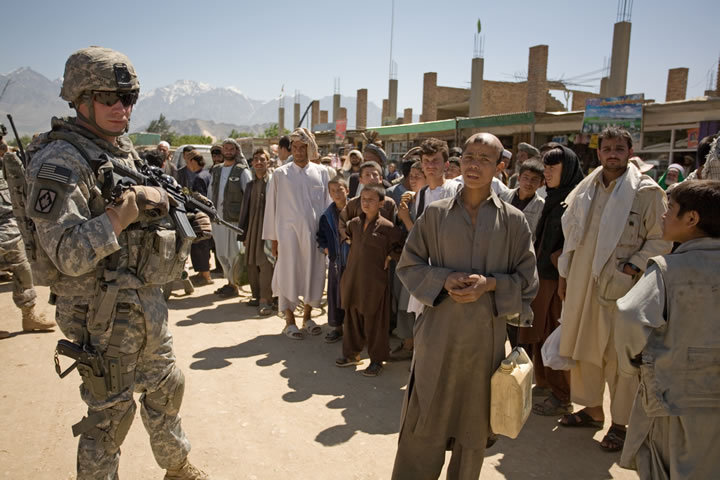
U.S. Army’s Provincial Reconstruction Team (PRT) and residents, Afghanistan.
[Original by Hiroshi TANIYAMA, JVC’s President (March 29, 2016); Translated by Y. Nakamura] The Security Laws were enforced on March 29, 2016, which makes it possible to exercise the right of collective self-defense for defending foreign countries by force of arms, and to support foreign forces anywhere in the world. Until now, JVC had set up “NGO Hisen Net (NGO NO WAR NETWORK)” together with about seventy other NGOs and has been strongly opposed to the Security Laws as a NGO involved in international cooperation. Japan becomes an assailant in conflicts. A hope for peace is about to be lost from the world once more. The Self-Defense Forces of Japan…
Fukushima’s “reconstruction” is a long way from people’s peace and safety
[Original by Hiroshi TANIYAMA, JVC’s President (March 12, 2016); Translated by Y. Nakamura] Five years have passed since the Great East Japan Earthquake and the nuclear accident at the Fukushima Daiichi Nuclear Power Plant. Decontamination and other arrangements towards reconstruction have been making progress in Minami-soma, where we have been providing assistance since April, five years ago. Last month, the City of Fukushima announced its policy that they would lift the ban on living in the area of Odaka, located within the range of 20km from the Daiichi Nuclear Power Plant. At first, the reconstruction looks to be progressing satisfactorily. However, the division among the people of Fukushima, which was…
From the place of conflicts in Africa, thinking about of the Right of Collective Self-Defense, “Kaketsuke-Keigo”
* This report was made open to the public on the JVC’s Japanese web site in July, 2014, and had received many accesses in the fiscal year of 2015, when the argument about security legislation became most heated in Japan; [Original by Takaki IMAI, Sudan Project (July 11, 2014); Translated by S. Thapa] On 1st July, 2014, the Japanese cabinet made a decision to approve the use of force overseas in the name of the right of collective self-defense. The Prime Minister of Japan refers to “kaketsuke-keigo” as one of reasons why the right of collective self-defense will be used. It means that when a NGO’s staff like me who…
A lot of problems in “Kaketsuke-Keigo” by the Self-Defense Forces in South Sudan
[Original by Hiroshi TANIYAMA, JVC’s President (February 5, 2016); Translated by Y. Nakamura] President Taniyama joined JVC in 1986 and has conducted activities in many local sites overseas. About the current issues around the world that should not be ignored, he is speaking specifically from a viewpoint of a NGO for international cooperation, which is familiar with the reality overseas. (Hiroshi Taniyama, JVC’s president, had been assigned to reside in Thailand, Laos, Cambodia, and Afghanistan for twelve years in total. Besides being the president of JVC, he is also the chairman of JANIC, one of the most influential NGO for international cooperation with the type of networking in Japan, and…
What I wish Paris as an Arabist
* This article has been posted to the Japanese webpage of the JVC in November 2015, just after the terrorist attack that happened in Paris.[Original by Mai NAMIKI, Palestine Project (November 19, 2015); Translated by K. Takemura/S. Thapa] Hello, I am Mai Namiki, in charge of the Palestine project of JVC. As one of the Arabists, who loves Arabian countries, cultures and people, I wish to express my thoughts on the terrorist attack that happened in Paris on November, 2015. I have been learning the Arabic language and the cultures of the Middle East since the age of 19 — for 12 years now. I have been there sometimes, living…